

The Best Iris Fragrances: Powdery, Elegant, and Quietly Sophisticated
The aromatic character lives in the underground rhizome aged for years before yielding orris butter, the priciest natural in commercial fragrance.
By Julia MorettiFragrenza makes several of the alternatives featured in our guides — here’s how we test.
13 min read
Iris is the most quietly luxurious note in fine perfumery. There is a particular kind of elegance that does not announce itself — it simply exists, effortlessly and without apology — and that is exactly what iris does in a composition. Cool, powdery, possessed of an almost architectural precision, iris (or orris, derived from the iris root) is one of the most refined and complex ingredients in the perfumer’s palette. It smells simultaneously of fresh violet petals, cool earth, soft chalk, warm powder, and faintly of carrot — a combination that is utterly unique in the natural world and has anchored the most sophisticated perfumery of the last 150 years.
This is the guide. What iris actually is and the labor-intensive process that gives it its character, what iris smells like across its various expressions, the cultural history of orris in French perfumery, the chemistry behind the powdery effect, the famous iris compositions worth knowing, and six Fragrenza picks distributed across the iris registers. Read in order or skip to the section you need.
What iris actually is
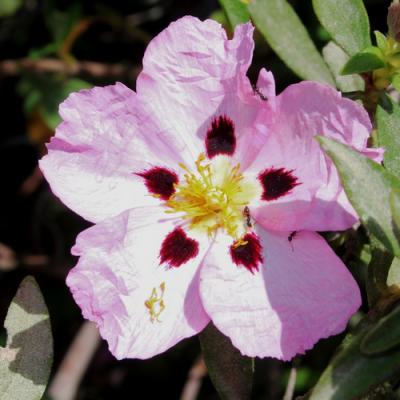
The iris note in perfumery does not come from the iris flower — it comes from the rhizome, the underground root system. The flowers are aesthetically remarkable but olfactorily inert; the perfumery character lives in the rhizome, which must be aged for years before it yields the materials that fine fragrance demands. The species cultivated for perfumery is primarily Iris pallida, grown most famously in Tuscany and to a lesser extent in Morocco, India, and a handful of other regions where the climate produces rhizomes with the right aromatic profile.
The processing is what makes iris one of the most expensive natural materials in commercial fine fragrance. The harvested rhizomes must be dried for at least three years — sometimes longer for the most prized material — during which an enzymatic process converts the precursor compounds in the root into irones, the aromatic molecules responsible for iris’s distinctive character. Without the multi-year aging, the rhizomes simply do not smell like iris. With it, the dried roots are then ground and steam-distilled or extracted to produce orris butter — a thick, pale-yellow waxy material that melts at body temperature and is one of the most beautiful aromatic substances in fine perfumery. The labor and the patience involved are why orris butter regularly costs $50,000 to $100,000 per kilogram, depending on quality and origin.
Three iris materials matter in modern perfumery. Orris butter is the gold standard — expensive, deep, complex, the material flagship niche compositions specify. Orris concrete is a more affordable extraction with similar but less refined character; most contemporary commercial iris compositions use orris concrete blended with synthetic irones rather than full orris butter. Synthetic irones (alpha-irone, gamma-irone, methyl ionone) capture specific facets of the iris profile and are widely used to extend or replace natural orris in mass-market fragrance. The most successful iris compositions blend small amounts of natural orris with significant percentages of synthetic irones, producing a vivid iris character that consistent natural-only formulation cannot match.
What iris actually smells like
Iris is one of the harder notes to describe because it sits across multiple olfactory registers at once. The dominant character is powdery — soft, talcum-like, with the cool quality of a clean linen closet. Underneath the powder sits something rooty and slightly carrot-like, an earthy thread that reminds the nose that this material comes from a root rather than a flower or a fruit. There is a violet facet (irones share aromatic chemistry with violet ionones), a chalky-mineral quality that some perfumers describe as “cold-stone,” and a creamy-buttery warmth in the dry-down that comes from the rhizome’s natural waxy content.
The double character of iris — cool-precise on the surface, warm-creamy underneath — is exactly what gives the note its sophisticated reputation. Where other floral materials are essentially one thing (rose is rose, jasmine is jasmine), iris is layered: it presents a different facet on first wear than it does an hour in, and the development is part of the reward.
Origin and grade affect the profile meaningfully. Tuscan orris (from Iris pallida) is the lushest and most prized, with the strongest carrot-rooty character and the warmest dry-down. Moroccan orris is generally drier and more powdery. Indian orris tends to be more violet-floral and less rooty. Most luxury iris compositions specify Tuscan orris where budget permits.
Cultural history of iris in perfumery
Iris has been part of European perfumery since the Renaissance, when Florentine orris was traded across the Mediterranean as both a fragrance material and a hair powder. The Tuscan iris-growing tradition that survives today is essentially continuous with the medieval one — the same species, the same drying process, often the same family-owned farms that have produced orris for centuries. Florence remains the spiritual center of fine orris production.
French fine perfumery adopted orris as a structural material in the eighteenth century and never let go. The great powdery feminines of the late nineteenth and early twentieth centuries — Guerlain’s Après L’Ondée (1906), Houbigant’s Quelques Fleurs (1912), Chanel’s No. 5 (1921) — all use iris as a structural heart note, contributing the powdery, refined character that defines what “classic French perfume” smells like in the cultural imagination. The post-war decades produced refinements rather than fundamental innovations on this lineage; iris continued as a structural fixture of luxury perfumery without becoming the headline material.
The contemporary iris moment began around 2005, when Prada Infusion d’Iris (2007) and Serge Lutens Iris Silver Mist (1994 but rediscovered in the 2000s) both demonstrated that iris could be the headline rather than the supporting material. Prada Infusion d’Iris stripped iris back to its most elemental cool-soapy-clean form; Iris Silver Mist pushed the rooty-carrot character to its extreme. Between them, the two compositions opened a new chapter in iris perfumery, and the niche tradition since has produced dozens of iris-forward releases at every price point. Iris in 2026 is more visible as a category than at any point in its commercial history.
Famous iris fragrances
Several compositions deserve study because they show what iris can do at the headline. Guerlain’s Après L’Ondée remains the genre benchmark for the soft-powdery-iris register and is still in production over a century after launch. Chanel’s No. 5 uses orris structurally rather than as headline, contributing the powdery refinement that has anchored the composition since 1921. Prada’s Infusion d’Iris is the canonical modern iris — cool, soapy, clean, and architectural. Serge Lutens’ Iris Silver Mist is the radical-rooty extreme of the category. Chanel’s 28 La Pausa (Les Exclusifs) demonstrates the contemporary luxury iris register at its most refined. Frederic Malle’s Iris Poêtique pushes natural orris to near-soliflore concentration. The Fragrenza catalog has interpretations of several adjacent registers, covered below.
Six Fragrenza iris picks
Six compositions in the Fragrenza catalog place iris at the heart of the wear, each working in a distinct register.
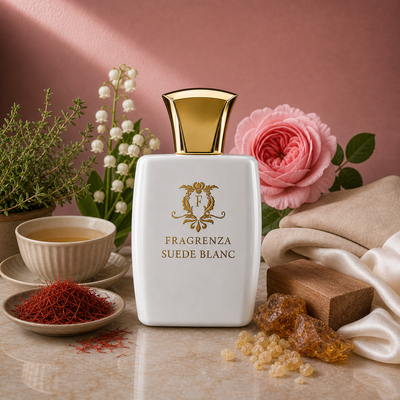
The powdery-suede register
sits in the iris-adjacent powdery-suede register. The composition pairs saffron and lily of the valley with a soft suede accord and sacred olibanum to create something that feels genuinely sumptuous — like the inside of a luxury glove. While the formulation does not center iris itself, the cool-powdery-elegant character lives in the same olfactory neighborhood, and it is the Fragrenza pick for those who want that quiet sophistication in a suede-led wear rather than a strict iris composition.
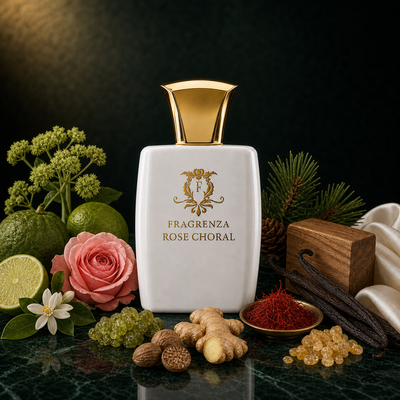
The iris-and-rose register
occupies the powdery-floral register adjacent to iris-rose without containing iris itself. A classical full rose meets galbanum, ginger, saffron, and a whisper of pine, anchored by sandalwood, vanilla, frankincense, and clean musk. The cool-meets-warm structural dialogue that defined twentieth-century French iris-rose perfumery is rendered here through a different palette but with the same architectural restraint. It is the Fragrenza pick for those who want that iris-rose mood in a rose-led, slightly aromatic-spiced wear.
The iris-and-saffron register
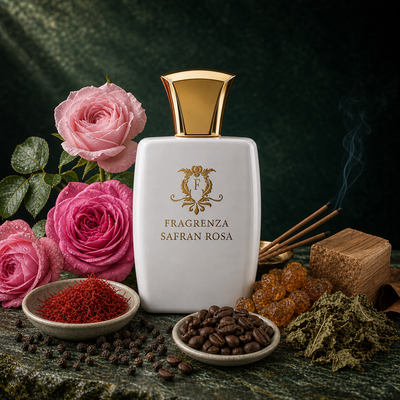
sits in the powdery-warm register that iris-and-saffron compositions traditionally occupy, without using iris in its own structure. Molten saffron and black pepper open onto a triple-rose heart (Rose de Mai, Turkish, Bulgarian), settling into roasted coffee, incense, amber, sandalwood, and patchouli. The powdery-elegant character of the iris-saffron tradition is captured here through a saffron-led palette rather than an iris-led one. It is the Fragrenza pick for those who want that iris-saffron mood in a richer, saffron-rose composition built for cooler-weather wear.
The first-impression register
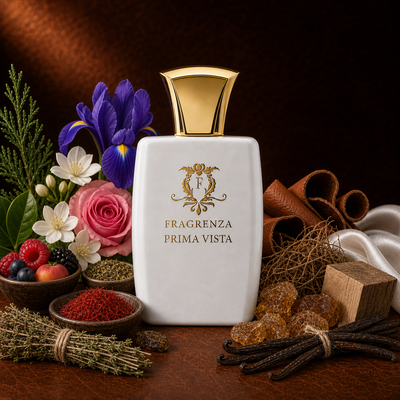
uses iris as the structural center of a composition built for the immediate, vivid first impression. The iris is bright and well-rendered — less the carrot-rooty extreme, more the cool-precise modern register that Prada Infusion d’Iris helped define. It is the iris pick for everyday wear and for those who want the note in its most contemporary form.
The gourmand-iris register

The chypre-iris register
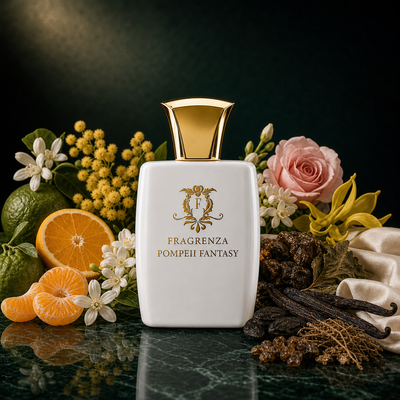
One additional Fragrenza pick deserves a callout for the rose-peony-elegance register adjacent to iris-floral compositions:
(Adeline) opens with lychee and rhubarb, blooms through a Turkish rose, lily-of-the-valley, and peony heart, and settles into a base of vanilla, white musk, cashmeran, precious woods, and frankincense. It does not contain iris itself but inhabits the refined-feminine floral register that iris compositions have long defined. It is the Fragrenza pick for those who want that quiet-elegant character in a rose-peony composition with a soft vanilla-cashmeran finish.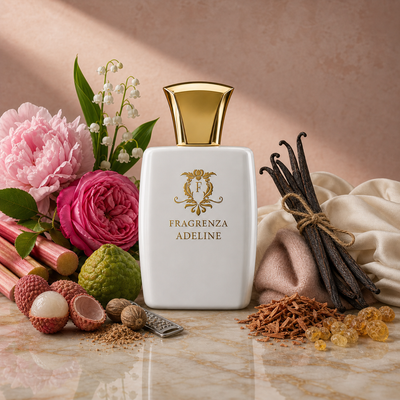
How iris interacts with other notes
Iris is one of perfumery’s great structural materials precisely because it pairs so productively with such a wide range of categories.
With rose, iris produces the iris-rose accord that has anchored luxury feminine perfumery for over a century. The cool-powdery iris balances the warm-rounded rose; together they form one of the most refined floral structures in fine fragrance.
With violet and white florals, iris reinforces the powdery-floral register and produces compositions of considerable elegance. Iris and ionones (the molecules that give violet its character) share aromatic chemistry, and the pairing produces a powdery-floral that is more dimensional than either material alone.
With musk, iris gains skin-integrated wear — the modern, more contemporary iris that wears closer to the body and reads as personal rather than projected. Most modern niche iris compositions use this structure.
With sandalwood, iris creates the creamy-powdery base that defines many of the great oriental-iris compositions. The sandalwood’s warmth softens iris’s cool precision into something more enveloping.
With patchouli, iris produces the chypre-iris register that contemporary luxury feminine perfumery has perfected. The patchouli grounds the iris; the iris gives the patchouli refinement.
With vanilla, iris becomes the iris-vanilla gourmand — sweet but cool, warm but powdery. The combination is one of the structural patterns of modern feminine perfumery.
With leather, iris produces the elegant-leather register that 1940s leather chypres pioneered and contemporary niche has revived. The iris’s coolness contrasts with the leather’s warmth in a way that reads as both sophisticated and slightly austere.
Iris in the modern wardrobe
Iris is one of the most genuinely seasonal-flexible notes in fine perfumery. The cool-precise quality wears beautifully in summer, where heavier compositions feel oppressive; the warm creamy dry-down works in cooler weather. Iris-rose and iris-vanilla compositions handle autumn and winter; iris-soap and iris-musk handle spring and summer. The category as a whole spans more contexts than most florals can.
The note also rewards confident, restrained wear. Iris is generous on skin but never aggressive — over-application is the most common mistake, and it pushes the wear from quietly elegant into powdery-heavy territory. Two sprays for the more refined compositions is the right default.
For the architectural framework on how iris-forward compositions fit a wardrobe, our complete guide to building a fragrance wardrobe in 2026 places iris alongside other floral and oriental categories. For the mood register iris occupies — polished, refined, quietly confident — our guide to choosing perfume by mood covers the territory in detail. For more on the floral register that iris anchors, our jasmine pillar covers the warmer end of the same family.
Frequently asked questions
What does iris smell like?
Powdery, cool, slightly carrot-rooty, with a violet floral facet, a chalky-mineral coolness, and a creamy-buttery warmth in the dry-down. The character is a contradiction: simultaneously cool and warm, precise and soft, mineral and floral. Most people describe iris as “quietly elegant” or “sophisticated powder” — the words gesture at the right register without quite capturing the specific character.
Why is iris so expensive in perfumery?
Two reasons. First, the rhizomes must be aged for at least three years before they produce the irones that make iris smell like iris. Second, the yield is small — roughly one kilogram of orris butter from one ton of dried rhizomes. The combination of multi-year processing time and low yield drives the price to $50,000-$100,000 per kilogram for premium Tuscan orris butter, making it one of the most expensive natural materials in commercial fine fragrance.
Is iris a flower or a root?
The iris note in perfumery comes from the root (rhizome), not the flower. The flowers are visually beautiful but olfactorily inert — they have very little aromatic content. The root, after multi-year drying, develops the irones that make iris-the-perfume-note smell like what it does. This is why iris perfumery has the rooty-carrot character that pure floral notes lack.
Can men wear iris fragrances?
Yes — iris is among the most genuinely unisex floral notes in modern perfumery. The Western convention has often coded iris as feminine because of its association with classical French powdery feminines, but the note itself is structural rather than gendered. Modern niche iris compositions (Iris Silver Mist, Dior Homme’s iris-iris-iris architecture, several Maison Francis Kurkdjian works) are explicitly unisex or men’s, and the contemporary masculine perfumery audience has embraced iris as a characterful note.
What is the difference between orris butter and orris concrete?
Both come from aged iris rhizomes, but the extraction methods produce different materials. Orris butter is solvent-extracted and contains higher concentrations of irones — richer, deeper, more refined, and significantly more expensive. Orris concrete is the more affordable extraction used in most mainstream commercial iris compositions. The most luxurious iris fragrances specify orris butter; most everyday iris compositions blend orris concrete with synthetic irones to capture the character at lower cost.
Are iris fragrances long-lasting?
Moderately. Iris is technically a heart note, with substantivity that sits between top notes (citrus, light florals) and base notes (oud, sandalwood, musk). A well-built iris fragrance typically wears for six to eight hours, with the powdery dry-down lasting longer on skin than the brighter top-of-iris facets. Iris compositions built on warm bases (sandalwood, vanilla, musk) wear longer than those built on lighter bases.
What perfumes layer well with iris?
Rose is the classical partner (the iris-rose accord). Vanilla creates the iris-gourmand register. Sandalwood softens iris into a creamy-powdery base. Musk gives iris skin-integrated wear. Patchouli produces the chypre-iris contrast. Saffron adds warmth and exotic depth. Avoid layering iris under heavily aquatic or sharply citrus-led compositions — the contrast between cool-powder and bright-cool tends to read as awkward rather than complementary.
The bigger picture
Iris is the most quietly luxurious note in fine perfumery. It does not announce itself; it simply elevates whatever it sits inside. Whether you wear iris for the powdery-suede register, the iris-rose elegance, the saffron-warm exotic, the contemporary cool-modern, the gourmand-feminine, or the chypre-sophisticated, the note belongs in any wardrobe that values restraint and refinement. Learning to recognize iris — its powdery cool surface, its rooty-creamy dry-down, the way it lifts and refines whatever it’s paired with — is one of the most useful skills any fragrance lover can develop. It is the note that tells you the perfumer was paying attention.