

Immortelle in Perfumery: The Everlasting Flower With an Unforgettable Scent
Helichrysum italicum from Corsica and Sardinia carries 2,4,6-trimethylacetophenone and related diketo compounds that build the curry-honey-hay accord no other floral in the palette quite reaches.
By Julia Moretti 6 min read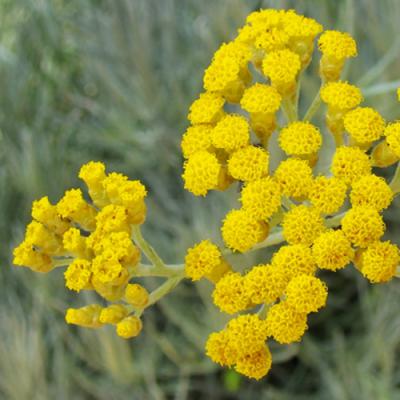
There are fragrance notes that surprise you, notes that delight you, and then there are notes that genuinely unsettle you with their strangeness. Immortelle — also known as everlasting flower or helichrysum — belongs to this last category. Its scent is one of perfumery's great rarities: a combination of warm honey, dry hay, curry spice, and something almost medicinal that defies easy classification and rewards every attempt to understand it.
The immortelle plant, Helichrysum italicum, grows wild across the rocky hillsides of the Mediterranean — particularly Corsica, Sardinia, and the Croatian coast. Its small, bright yellow flowers are famously durable; even when cut and dried, they retain their color and structure for months, which is the origin of both the French name immortelle (everlasting) and the English alternative, everlasting flower. This physical permanence seems almost appropriate for a plant whose aromatic character is so indelible and so difficult to forget once encountered.
The Extraordinary Smell of Immortelle
Attempting to describe immortelle to someone who has never encountered it is one of perfumery writing's genuine challenges. The dominant impression is of warm, dry sweetness — something between honey and maple syrup — but this sweetness is immediately complicated by a curry-like spiciness that seems almost incongruous in a floral material. Underneath both of these registers lies a hay-like, slightly earthy quality, and the whole accord is unified by a faintly medicinal or herbal undertone.
The curry association is the most disorienting aspect for new encounters. It comes primarily from diketo compounds — particularly 2,4,6-trimethylacetophenone and related molecules — that produce a distinct fenugreek-curry character not commonly found in floral materials. This is what makes immortelle so unusual and so valuable: it introduces a savory, spicy dimension into what would otherwise be a conventional sweet floral accord, creating genuine complexity and surprise.
In perfume compositions, immortelle usually appears in the heart, where it functions as a center of gravity. Its warmth is real and lasting; it does not flash off like citrus, nor does it retreat entirely into the background like many musks. It sits in the composition with authority, evolving slowly and revealing new facets as the fragrance dries down on skin.
A Plant With Ancient Mediterranean Roots
Helichrysum italicum has been used medicinally in the Mediterranean for at least two thousand years. Ancient Greek physicians recommended preparations of the plant for wound healing and as an anti-inflammatory, and this medical use persisted through the Arab medical tradition and into European herbalism. The plant's remarkable durability — that quality that earns it the name everlasting — was understood symbolically as well as practically, and helichrysum appears in various folk traditions as a symbol of eternity and remembrance.
In Corsica, where some of the finest immortelle absolute is still produced today, the plant is deeply embedded in local culture. The scent of sun-warmed immortelle drifting down from the island's maquis scrubland is for many Corsicans an essential part of the island's identity — the olfactory signature of home. Perfumers who have visited the island in bloom season often describe the experience as transformative, an encounter with a scent character so distinctive and so complex that no description fully prepares you for it.
In modern niche perfumery, the Corsican origin story has itself become part of the marketing around immortelle. Fragrances that feature the note often make explicit reference to Mediterranean landscapes, maquis vegetation, and the golden hillsides of the island. Whether or not the wearer has ever set foot in Corsica, this narrative gives immortelle a geographical and emotional anchor that deepens its appeal.
Extraction and Key Molecules
Immortelle absolute is produced through solvent extraction of the dried flowers of Helichrysum italicum. It is one of the relatively few flower absolutes where the result closely resembles the actual smell of the living plant — a quality that makes it particularly valued by natural perfumers. Steam distillation is also used to produce helichrysum essential oil, though the absolute tends to be preferred for its fuller, more complex character.
The dominant aromatic compounds in immortelle include neryl acetate, which provides a fresh, slightly citrusy dimension; italidiones, a group of diketo compounds responsible for the characteristic curry-fenugreek character; and various sesquiterpenes that contribute depth and longevity. Eugenol is also present, adding a subtle spicy warmth that connects immortelle to the clove-carnation family.
On the synthetic side, the italidione family of molecules has attracted significant attention from aroma chemists. Several synthetic analogs are now available that replicate specific facets of immortelle's character — the curry note, the honey-sweetness, the hay quality — and these are increasingly used alongside or in place of the natural absolute in commercial compositions. However, many perfumers maintain that the natural material, in all its complexity and unpredictability, cannot be fully replaced by any synthetic reconstruction.
Famous Fragrances Featuring Immortelle
Immortelle's unusual character has attracted some of the most adventurous perfumers in the industry. It appears most notably in niche fragrance contexts, where its curry-honey complexity is treated as a feature rather than a challenge to be softened.
The note is a cornerstone of several celebrated recent fragrances from houses like L'Occitane, which has used Corsican immortelle as a signature ingredient across a range of its fragrance and skincare lines, and various artisanal natural perfumers who have built entire collections around helichrysum's extraordinary character. In these compositions, immortelle is allowed to be fully itself — savory, sweet, strange, and deeply beautiful.
In designer fragrance, immortelle often appears in supporting roles, contributing warmth and complexity to broader oriental or woody constructions without necessarily announcing itself by name. The note's honey and hay dimensions integrate particularly well into amber accords, and several well-known oriental fragrances for both men and women carry immortelle's DNA without featuring it explicitly on the label.
Note Interactions: Immortelle in Context
Immortelle's most productive partnerships exploit either its honey dimension or its spicy-curry character, or use the tension between the two as the central compositional idea.
With lavender — its most natural aromatic companion from the Mediterranean landscape — immortelle creates a warm, herbal-honey accord that is both familiar and unusual. This pairing is the heart of many Provencal-inspired compositions, and it has a naturalness that speaks to the two plants' proximity in their native habitat.
With vanilla and tonka bean, immortelle builds toward a sweet, slightly exotic oriental warmth. The honey dimension of the flower blends seamlessly with vanilla's creamy sweetness, while the curry-spice facet prevents the accord from becoming too simple or straightforwardly sweet. This combination appears in numerous mainstream oriental compositions, often without immortelle being explicitly identified.
With hay, dried grasses, and other dry botanical materials — including hay absolute itself — immortelle builds toward a landscape accord of extraordinary evocativeness: the smell of a summer field in the Mediterranean heat, with all the aromatic complexity that implies.
With oud and other deep, animalic base materials, immortelle can take on an almost narcotic intensity. The curry-spice facet links to oud's own complex, faintly barnyard-and-leather character, and the combination creates a fragrance that is unmistakably serious — the olfactory equivalent of ancient ritual.
Immortelle in the Contemporary Wardrobe
Immortelle fragrances are among the most genuinely distinctive and memorable in all of perfumery. They do not blend into the crowd. A fragrance built around helichrysum absolute announces a wearer who has specific and unusual taste, who is not interested in blending invisibly into the fragrant mainstream.
These fragrances reward warm skin and warm weather, which activates the honey-curry complexity and allows it to fully unfold. In cold weather, immortelle can read as flat or muted; in heat, it becomes something extraordinary — an almost overwhelming bouquet of sweet, spicy, golden warmth that seems to capture the smell of an entire landscape.
For those who have found themselves bored by conventional floral or woody compositions and are looking for something genuinely different, immortelle represents one of perfumery's most exciting frontiers. It is the note that reminds you that the art form's possibilities extend far beyond rose and musk, that the natural world contains aromatic materials of breathtaking strangeness and beauty, and that the best perfumers are still finding new ways to bring these materials into contact with human skin.