

Orchid in Perfumery: The Exotic, Sensual Bloom That Defies Easy Definition
Orchid is one of perfumery's most beloved floral notes. Learn how perfumers use it, what it smells like on skin, and the fragrances that wear it best.
By Julia Moretti 6 min read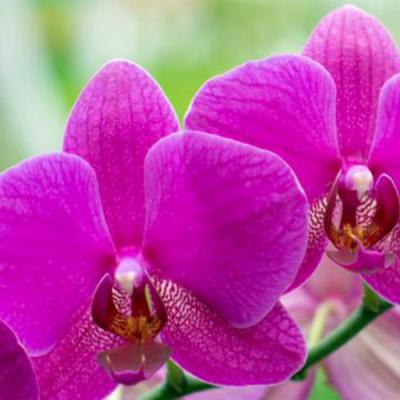
The Paradox of Orchid: The Flower That Has No True Scent in Perfumery
Orchid is one of the great paradoxes of modern perfumery. It is listed prominently among the notes of countless celebrated fragrances, it has been used as the name and concept of legendary compositions, and yet there is no commercially available orchid absolute — no extract distilled or pressed from an orchid flower that a perfumer can reach for in the same way they reach for rose or jasmine absolute. The orchid note in perfumery is, almost entirely, a creative construction: an olfactory impression built from other ingredients, designed to evoke what perfumers and consumers imagine an exotic orchid should smell like.
This is partly a botanical reality. The orchid family (Orchidaceae) is the largest family of flowering plants on earth, comprising roughly 28,000 species — and while many orchids are indeed fragrant, their aromatic compounds are typically produced in such small quantities and are so chemically complex that extraction is not commercially viable. The scent also varies enormously between species: Vanilla planifolia, the vanilla orchid, smells of vanilla (from which the culinary spice is derived); some species of Gymnadenia smell of cloves or honey; others are scentless altogether.
What the Orchid Note Smells Like in Practice
Because orchid is a constructed note rather than a natural extract, its profile varies according to the perfumer's intention and the broader context of the composition in which it appears. That said, several consistent characteristics emerge across the canon of orchid-themed fragrances. The orchid accord tends to be simultaneously floral and creamy, with a slightly powdery quality that suggests delicacy and luxury. There is often a vanillic warmth at its core, a nod to the orchid's most famous aromatic relative — indeed, some orchid accords are little more than a sophisticated vanilla with floral and musky facets woven around it.
The most common interpretation of orchid in mainstream perfumery leans toward something rich, sensual, and slightly abstract: a floral note that does not resolve into any single recognisable flower but instead creates a generalised impression of exotic bloom — lush, tropical, and vaguely sweet. In niche perfumery, orchid treatments can be considerably more adventurous, exploring the green, slightly rubbery facets of certain orchid species, or pushing the vanillic angle so far that the fragrance becomes almost a perfumed food.
The Ingredients Behind the Orchid Accord
Perfumers building an orchid accord draw from a varied palette of natural and synthetic materials. Heliotropin (piperonal) is one of the key building blocks: a molecule with a sweet, almond-cherry-floral character that contributes the powdery-sweet quality associated with many orchid impressions. Coumarin adds a soft, hay-like sweetness. Vanilla — whether as vanillin, ethyl vanillin, or natural vanilla absolute — provides warmth and creaminess. Musks of various kinds — white musks, lactonic musks, skin musks — give the orchid accord its characteristic softness and intimacy.
Floral contributions might come from jasmine molecules like methyl dihydrojasmonate (Hedione), which adds a light, transparent floral quality without dominating, or from synthetic musks that carry a vaguely floral, skin-like warmth. Some perfumers use ylang-ylang in trace amounts to add the rubbery, tropical floral quality that certain exotic orchid species possess. Benzyl salicylate, a solar, slightly floral and balsamic molecule, appears in many orchid accords to add diffusion and a vaguely tropical warmth.
The result, when executed well, is genuinely evocative — even if it does not correspond to any botanical reality. The orchid note represents perfumery operating at its most creative and unconstrained: not reproducing nature but inventing it, creating a new olfactory experience that exists nowhere in the natural world but feels immediately right.
Orchid's History in Perfumery and Its Cultural Associations
The orchid became a cultural symbol of exotic luxury and sensuality during the Victorian period, when plant collectors and botanists returned from tropical regions with extraordinary specimens that sparked a mania for orchid cultivation among the European elite. The flowers' elaborate beauty and rarity made them objects of almost fetishistic desire — a quality that transferred naturally to the world of fragrance, where orchid became shorthand for something intensely desirable and slightly transgressive.
The first major fragrance to deploy orchid as a concept rather than a specific ingredient was probably Bourjois' Soir de Paris in the 1920s, though it was not until the latter decades of the twentieth century that orchid truly became a fragrance marketing phenomenon. The 1990s and 2000s saw an enormous proliferation of orchid-themed fragrances, as the note's combination of exotic allure, contemporary cleanliness, and vanillic warmth proved reliably commercially successful.
Today, orchid occupies a fascinating position in the perfumery landscape: it is simultaneously one of the most recognisable note labels for consumers and one of the least botanically coherent in terms of what perfumers actually use to create it. This gap between marketing language and raw materials is not unique to orchid, but it is perhaps more dramatic there than with any other common fragrance note.
Iconic Orchid Fragrances
Tom Ford Black Orchid is arguably the definitive orchid fragrance of the modern era and one of the most ambitious uses of the note in commercial perfumery. Created in 2006, Black Orchid is a deliberately theatrical composition — dark, opulent, and intensely sensual. The orchid note here is not light or powdery but rather rich and almost animalic, surrounded by truffle, black plum, ylang-ylang, dark chocolate, incense, and a deep patchouli-sandalwood base. It is orchid as primal excess — beautiful and somewhat overwhelming.
Mugler Alien uses a Cashmeran-jasmine-woody musk accord that many interpret as a kind of orchid-adjacent floral — warm, slightly abstract, intensely diffusive. Carolina Herrera Good Girl places orchid alongside jasmine, cocoa, and tonka bean in a fragrance architecture that reads as glamorous and slightly dark, with the orchid contributing its characteristic creamy floral quality to the overall impression of dressed-up femininity.
In niche perfumery, several houses have explored orchid with considerable sophistication. Guerlain's Spiritueuse Double Vanille references the vanilla orchid explicitly in its extraordinary vanilla-cognac-iris composition. Niche fragrances in the floral-oriental space frequently use orchid accords as a linking element between the floral heart and the warm, resinous base, exploiting the note's natural affinity for both families.
Note Interactions and Wardrobe Placement
Orchid's greatest compositional strength is its versatility as a connector note. Its simultaneously floral, vanillic, and musky character allows it to bridge families that might otherwise feel discontinuous: it can make a floral composition feel warmer and more sensual without making it feel oriental, or it can soften an oriental base enough to wear in warmer weather without sacrificing depth. This connective function explains why orchid accords appear so frequently in the middle and base notes of contemporary feminine fragrances, where structural coherence is often as important as individual note brilliance.
Orchid pairs beautifully with sandalwood, which mirrors its creamy warmth while adding woody depth. Against musk, orchid becomes skin-like and intimate, producing the impression of a scent that seems to emanate from the wearer's own body rather than from a bottle. With patchouli, orchid takes on a darker, earthier dimension — as demonstrated to spectacular effect in Tom Ford Black Orchid.
In terms of wardrobe placement, orchid fragrances span an unusually wide range. Light, musky-floral orchid compositions work well as everyday wear — approachable, clean, and universally appealing. Darker orchid fragrances like Black Orchid are evening and cooler-weather propositions, demanding occasions and environments that can accommodate their theatrical ambition. Any fragrance wardrobe benefits from at least one orchid-themed piece, if only as a reminder that perfumery at its best is not merely reproduction but invention — the art of creating something beautiful that has never quite existed before.