

Gourmand Floral Perfumes 2026: The Six Archetypes from Praline-Floral to Spicy Jasmine
Mugler's 1992 launch put patchouli and praline next to abstract florals without apologising, then Prada Candy in 2011 made iris and caramel feel grown-up rather than juvenile.
By Julia MorettiFragrenza makes several of the alternatives featured in our guides — here’s how we test.
14 min read
Gourmand and floral perfumery were considered separate territories for most of the late twentieth century. Florals occupied the fine-fragrance pedestal: rose absolutes, jasmine sambac, iris butter — materials that telegraphed sophistication and femininity. Gourmand notes — vanilla, caramel, praline, tonka — were treated as something looser, accessible, sometimes dismissed as candy. The two families coexisted but rarely merged on purpose. In 2026, that border has collapsed. Gourmand floral is the most commercially important hybrid category in modern perfumery, and the houses doing it well are producing some of the year's most genuinely beautiful work.
This is the 2026 guide to gourmand floral perfumery. What the category actually means, the cultural lineage that produced it, the six archetypes defining the year, and the Fragrenza picks that demonstrate each register. Read straight through, or jump to whichever archetype matches the perfume you already love.
What gourmand floral actually means
A gourmand floral isn't a floral perfume with sugar added. The category is more architectural than that. The defining structural choice is that the gourmand element and the floral element are both load-bearing — neither functions as decoration. A great gourmand floral lets you smell jasmine clearly and praline clearly, simultaneously, without either flattening the other. That balance is the whole craft.
The failure mode is immediate. When the gourmand swallows the floral, you get perfumed dessert — sticky, one-dimensional, generic. When the floral swallows the gourmand, you get the same flower you've smelled a thousand times with a faint vanilla afterthought. Both are common. Both are the reason this category had a long warm-up period before it became respectable. The compositions that earned the family its current status are the ones that hold the tension.
The pairing logic is dialectical rather than additive. Jasmine and caramel work because jasmine has its own fruity, slightly banana-like facets that the caramel discovers rather than imposes. Rose and praline work because the hazelnut quality of praline echoes the slightly dusty heart of certain rose absolutes. Tuberose and vanilla together are operatic — both are enormous, creamy, almost narcotic — and when balanced, they produce a fragrance that fills a room with extraordinary grace. Iris and almond may be the most intellectually interesting: iris's natural carrot and rootlike tones intersect with almond's marzipan bitterness to create something that reads as both antique and utterly modern.
The cultural and compositional history
The lineage is shorter than you might expect. Mugler's Angel in 1992 was the first commercial declaration that gourmand notes could share a composition with abstract florals without apologising — patchouli and praline anchoring red berries and honey, with the rose and jasmine in the heart almost lost in the sweet weight. Angel was a polarising moment, but it proved the architecture was possible.
The category's modern shape arrived with three early-2010s launches that codified the structural rules. Prada's Candy in 2011 paired iris and benzoin with caramel and positioned the result as a grown-up woman's fragrance rather than an adolescent confection. Kilian's Love Don't Be Shy in 2012 put neroli and marshmallow into open union, building the case that the gourmand floral could be opulent rather than juvenile. Lancôme's La Vie Est Belle in 2012 closed the loop commercially — iris, jasmine, orange blossom, praline, and patchouli, formulated for mass market and selling at scale that proved the audience had been waiting.
What those launches established was a crucial principle: sweetness, applied with editorial precision, does not diminish a fragrance. It deepens it. The earlier gourmand-floral attempts failed not on ambition but on execution. Too much caramel obscured the flower; too much rose overwhelmed the praline. The perfumers who cracked the formula understood that the relationship between the two families had to be dialectical, not additive.
The 2024-2026 wave has refined the category further. Contemporary gourmand florals lean drier than their 2010s ancestors. The vanilla is darker, the praline is less sugary, the florals are more naturalistic. The result is compositions that read as adult and considered rather than as marketed gourmand product. The category has earned its place in the canon.
The material palette
The vocabulary of modern gourmand floral perfumery sits at the intersection of two material families that, until recently, kept separate ledgers.
On the gourmand side: vanilla absolute (Madagascar, Tahiti, Comoros — each with a different character), tonka bean (with its coumarin signature — almond, hay, warm-skin), praline accords (built on hazelnut, brown sugar, caramelised milk), benzoin (resinous, vanillic, warm), caramelised sugar and caramel, white chocolate accords, and increasingly the broader gourmand family — pistachio, honey, fig, coffee in trace amounts. The choice of gourmand material sets the temperature of the composition.
On the floral side: jasmine grandiflorum and jasmine sambac (the two main jasmine varieties, with different indolic profiles), Turkish rose and Bulgarian rose (rose with depth versus rose with brightness), tuberose (the most narcotic floral), iris absolute and orris butter (powdery, root-like, expensive), orange blossom (honeyed-bitter, north-facing), magnolia (clean and lemony), peony (powdery and modern), ylang-ylang (creamy and exotic). The choice of floral material sets the personality.
The bridge materials — patchouli, cashmeran, soft musks, sandalwood, sometimes vetiver — are what keep the two families from collapsing into each other. They function as connective tissue, giving the composition somewhere to live between the florals' brightness and the gourmand notes' weight. Every great gourmand floral has at least one of these bridge materials doing structural work in the base.
The six gourmand floral archetypes of 2026
The category divides into six distinct registers in 2026. Each one represents a different decision about which floral and which gourmand note share the headline, and each has at least one Fragrenza interpretation worth knowing.
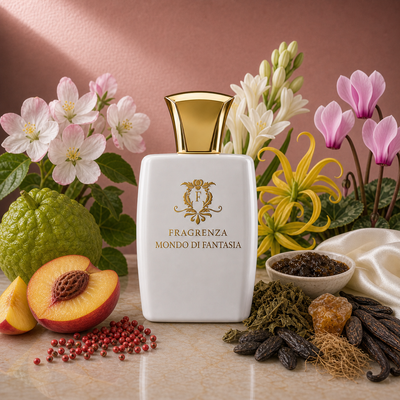
Joyful fruity-floral gourmand
The bright, daytime end of the category. Fruity-floral compositions softened by vanilla and tonka, anchored with patchouli or benzoin to keep them from going thin. Best for warmer weather, daytime wear, and anyone who finds the heavier praline-floral direction overwhelming.
is the canonical Fragrenza pick here. The opening blends bergamot with nectarine and apple blossom; the heart adds pink pepper, tuberose, and ylang-ylang for a floral expansion; the base sits on benzoin, tonka, vanilla, patchouli, and musk for a warm-but-not-sticky finish. The fruit gives the composition lift, the florals carry the body, the gourmand base anchors it without flattening anything. Wears beautifully spring through early autumn.
Praline-floral
The category-defining archetype — the one launched by La Vie Est Belle in 2012 and refined through a decade of imitators. Iris and jasmine sit in the heart; praline and vanilla sit in the base; orange blossom carries the bridge. The result is a fragrance that reads as quietly luxurious, distinctly feminine, and unmistakably gourmand.

Cherry-floral-amaretto
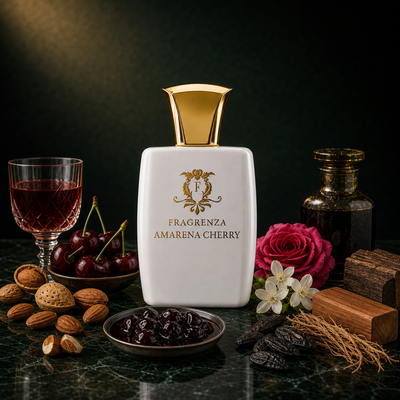
The 2026 archetype with the most growth momentum. Dark cherry — black cherry, griotte syrup, cherry liqueur — paired with Turkish rose and jasmine sambac, sweetened with bitter almond and roasted tonka, anchored on sandalwood and cedar. The result is a gourmand floral that reads as evening-leaning, slightly indulgent, and unmistakably modern.
(rendered as Amarena Cherry) is the Fragrenza interpretation. The architecture is faithful to the cultural reference: black cherry and cherry liqueur in the opening, griotte syrup and the rose-jasmine duet in the heart, Peru balsam and roasted tonka in the base. Bitter almond keeps the sweetness from collapsing into candy. Wears as autumn-into-winter evening fragrance and pairs particularly well with cool weather and warm clothing.
Rose-fruit-vanilla
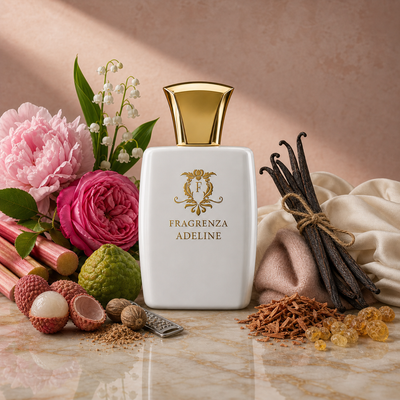
The romantic end of the category. Turkish rose and lily of the valley over a base of vanilla, white musk, and cashmeran — with fruit (lychee, rhubarb) in the opening to add brightness. Less weighty than the praline-floral; more openly feminine than the cherry-floral.
(rendered as Adeline) is the Fragrenza interpretation of this register. Lychee and rhubarb open it; Turkish rose, lily of the valley, and peony build the heart; vanilla, white musk, cashmeran, and a whisper of frankincense ground the base. The frankincense is what keeps the composition from sliding into the powdery-floral cliché — it adds a subtle vertical lift that gives the perfume room to breathe. Year-round wear, daytime-leaning, with enough warmth in the base for evening when needed.
Spicy jasmine-vanilla
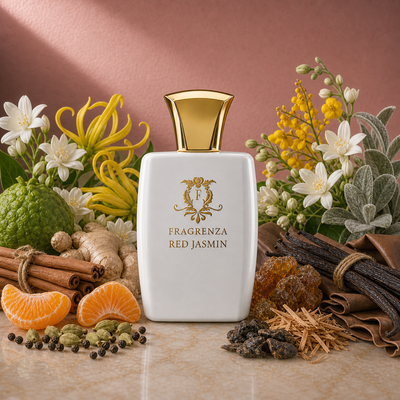
The boldest archetype in the category. Jasmine sambac and ylang-ylang at the heart, surrounded by cinnamon, ginger, cardamom, and black pepper for vertical lift, anchored on vanilla, amber, labdanum, and leather. The composition reads as opulent, distinctly evening-coded, and a clear step away from the powdery-femininity register.
is the Fragrenza pick. Cinnamon and ginger entwine with bergamot, cardamom, black pepper, and honeyed mandarin in the opening; jasmine and ylang-ylang dominate the heart, with neroli, broom, and clary sage as floral counterpoints; vanilla, amber, leather, and French labdanum anchor the base. The leather note is what differentiates this from a standard floral-vanilla — it gives the composition a sensual, almost animalic dimension that the other archetypes don't access. Evening wear, cooler weather, and bold occasions.
Floral-vanilla chypre
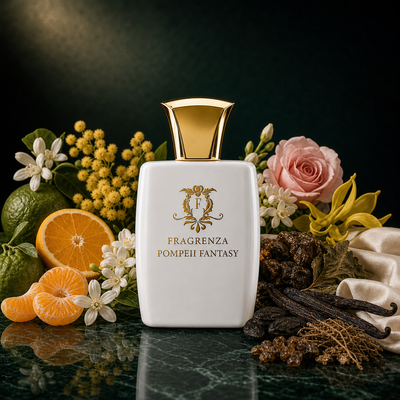
The most architecturally complex archetype, drawing on the classical chypre structure (citrus, floral heart, oakmoss-patchouli base) and grafting in vanilla and tonka to produce a gourmand-floral hybrid that reads as both timeless and modern. The category that most reliably reads as expensive.
How gourmand florals wear on skin
The category has its own behavioural signature, distinct from either parent family. The first thirty minutes are usually dominated by the floral — even in compositions where the gourmand element is the structural heart, the volatility of floral materials means they project first. By the second hour, the gourmand element rises and the floral settles back; the two are typically in their cleanest balance somewhere between hour two and hour four. By hour six, the floral has receded and the gourmand base does the rest of the work.
This wearing pattern matters for application. A gourmand floral applied 30-60 minutes before social contact will read at its most balanced when the wearer arrives. Spraying immediately before leaving the house puts the wearer in the floral-dominant opening, which can read overdone in close company. The post-shower window technique (covered in our longevity guide) is especially useful for this category.
Skin chemistry interacts with gourmand florals more visibly than with either pure family. Warm skin amplifies the gourmand element; drier or cooler skin shifts the balance toward the floral. The category rewards a four-hour wear test before commitment more than almost any other.
When and how to wear
The category is more flexible than its weight suggests. The Joyful fruity-floral and the Rose-fruit-vanilla archetypes are daytime-friendly and year-round. The Praline-floral and the Floral-vanilla chypre work across seasons and occasions and read as office-appropriate when applied with restraint. The Cherry-floral-amaretto and the Spicy jasmine-vanilla are evening and cooler-weather wear; both can overpower in hot weather or close indoor environments.
Application restraint matters more here than in most categories. Two sprays on chest and inner elbow is enough for most gourmand florals; three is reasonable for the heavier archetypes in cool weather; more than three almost always reads as overdone. Wrist application followed by hand-washing wastes the composition; chest and inner-elbow application produces the soft sillage the category rewards.
How to layer gourmand florals
Three useful patterns. To soften: layer with a clean musk skin scent underneath. The musk thins the floral element's intensity and makes the composition more wearable in warm weather or office contexts. To deepen: layer with a small amount of an oud or sandalwood composition. The wood note pulls the gourmand floral toward evening and adds substance to the dry-down. To brighten: layer with a fresh citrus or neroli composition on the pulse points only — the citrus stretches the opening without disrupting the floral-gourmand heart.
What rarely works: layering two gourmand florals. The category has enough structural weight that stacking two compositions almost always collapses the balance, producing a sticky, undifferentiated sweetness. Pick one gourmand floral as the headline and layer something simpler underneath or on top, not another full composition. Our broader layering guide covers the underlying principles.
Building a gourmand-floral mini wardrobe
A three-bottle gourmand floral wardrobe covers most occasions. One daytime option — Mondo di Fantasia or Adeline — for office, casual, and warmer-weather wear. One workhorse — Belle di Verona or Pompeii Fantasy — for the days when you want the canonical gourmand-floral architecture and year-round flexibility. One evening or cool-weather option — Amarena Cherry or Red Jasmin — for occasions where the heavier archetypes pay off.
If the wardrobe expands to five bottles, add the floral-vanilla chypre (Pompeii Fantasy) as the formal-occasion piece and the spicy jasmine-vanilla (Red Jasmin) as the bold-evening piece. The architecture covers virtually every social context the category is suited for. For the broader picture of how gourmand fits in a full wardrobe alongside the savory side of the family, see our Bright Gourmand pillar and the Savory Gourmand pillar.
Frequently asked questions
What is a gourmand floral perfume?
A gourmand floral is a fragrance that uses both floral materials (rose, jasmine, iris, tuberose, ylang-ylang, peony) and gourmand materials (vanilla, praline, tonka, caramel, benzoin) as load-bearing elements in the composition. Both families share the headline; neither functions as decoration. The category emerged with Mugler's Angel in 1992 and codified through Prada Candy (2011), Kilian Love Don't Be Shy (2012), and Lancôme La Vie Est Belle (2012). 2024-2026 represents the category's mainstream peak.
How is gourmand floral different from a sweet floral?
A sweet floral uses sugar or vanilla as a supporting element to soften an essentially floral composition — the floral leads, the sweetness follows. A gourmand floral makes both families load-bearing — the praline, vanilla, or caramel is structurally as important as the rose, jasmine, or iris. The category is architectural rather than decorative.
Are gourmand florals too sweet for everyday wear?
The 2024-2026 wave is deliberately drier than its 2010s predecessors. The vanilla is darker, the praline less sugary, the florals more naturalistic. Modern gourmand florals — applied with restraint, on chest and inner elbow rather than wrist — wear comfortably across daytime, office, and evening contexts. The lighter archetypes (Joyful fruity-floral, Rose-fruit-vanilla) are genuinely daytime-friendly; the heavier archetypes (Cherry-floral-amaretto, Spicy jasmine-vanilla) belong to evening and cooler weather.
What's the best floral note for a gourmand pairing?
Jasmine sambac is the most reliable workhorse — its slight indolic and fruity character bridges to caramel, praline, vanilla, and cherry seamlessly. Iris is the most sophisticated pairing partner because its rootlike powderiness complements praline and almond. Turkish rose works best with cherry and red-fruit gourmands. Tuberose is the most operatic partner for vanilla and is exceptional in opera-coded evening compositions but harder to wear casually.
Can men wear gourmand floral perfumes?
Yes — and increasingly do, especially in the cherry-floral-amaretto and spicy jasmine-vanilla archetypes where the structural weight and warm-spicy framing read as gender-neutral or masculine-leaning. The praline-floral and rose-fruit-vanilla archetypes lean more classically feminine but the category overall is far less gendered than it was a decade ago. The smellmaxxing wave in particular has expanded men's interest in gourmand and floral notes simultaneously, and gourmand floral sits squarely in the convergence.
How long do gourmand florals last on skin?
Six to ten hours for most well-built compositions; the heavier archetypes with patchouli, oud, or leather bases will hold past twelve. The category benefits from extrait or parfum concentrations more than from EDPs because the dry-down — where the gourmand base shines — is where the category lives. Application on moisturised skin and on heat-emitting points extends the wear meaningfully.
What's the best gourmand floral perfume for a first date?
The Praline-floral and Rose-fruit-vanilla archetypes are the most reliable choices — Belle di Verona, Adeline, or Pompeii Fantasy all read as warmly inviting without being heavy or polarising. Skip the spicy jasmine-vanilla register for first dates; the leather and spice elements can read as too bold before the relationship has context. Two sprays on chest and inner elbow, 30-60 minutes before arrival, is the working formula. (Our date-night fragrance guide covers the broader principles.)
A final note
The gourmand floral category is one of the few in modern perfumery where the architectural choice is also the cultural statement. Refusing to choose between sophistication and sensuality, between elevation and indulgence, between the perfume aisle's traditional binaries — that refusal is what the category is built on, and it's also what the wearer is communicating when they reach for one. Sweet, yes. Sophisticated, absolutely. And in the finest examples, something richer and stranger than either word alone can hold.
Related reads: Bright Gourmand: The 2026 Guide, Best Cherry Fragrances 2026, Best Vanilla Fragrances 2026, Honey Perfumes 2026, Savory Gourmand pillar, Wardrobe pillar, Mood pillar.