Sea Water in Perfumery: How Perfumers Bottle the Ocean in 2026
Sea water is a defining note of the modern aquatic family, a note every fragrance lover should learn to recognise on skin.
By Julia Moretti 9 min read
Few perfumery notes are more evocative or more misunderstood than sea water. The phrase conjures a specific sensory memory — salt air, sun on stone, wet skin, a hint of seaweed at the tide line — but the actual perfumery accord we call "sea water" or "marine" is a 20th-century synthetic invention rather than a literal extraction from the ocean. Understanding how perfumers build the sea water impression, and how it functions architecturally in modern fragrance, is foundational to literacy in the fresh-aquatic family that has dominated summer perfumery for the past three decades.
This guide walks through what sea water means as a perfumery note, the chemistry that produces the marine impression, the historical evolution from real seashore materials to modern synthetic accords, and how Fragrenza's catalog uses the marine register in its fresh-aromatic compositions. It's the kind of structural literacy that turns casual buyers into informed wearers.
What Sea Water Actually Is in Perfumery
Sea water as a perfumery note is an accord — a composed impression — rather than a single material. Perfumers build the marine impression from a combination of synthetic molecules, the most important of which is calone (technically methylbenzodioxepinone). Calone, introduced commercially in 1966 and broadly adopted in fragrance during the 1990s, delivers a specific olfactory signature that the brain reads as ocean spray, watermelon rind, and slightly salty air all at once.
Calone alone doesn't produce a convincing sea water accord — it tends to read as too sweet, too synthetic, too uniform. Perfumers combine calone with other materials to round out the impression. Helional adds a fresh aldehyde lift that recalls air over water. Floralozone contributes a slightly ozonic, atmospheric quality. Synthetic seaweed molecules add organic, slightly tide-pool depth. The resulting accord is greater than the sum of its parts — a marine impression that didn't exist in perfumery before the synthetic-chemistry era.
What Sea Water Smells Like in Compositions
The marine accord reads as cool, transparent, slightly salty, and atmospheric. It evokes the impression of being near water — specifically the boundary zone where ocean meets shore — rather than the impression of being submerged in it. Most marine fragrances actually capture the impression of the air over water rather than the water itself, which is why they typically combine calone-driven freshness with airy aldehydes and slightly mineral undertones.
The accord can read very differently depending on its supporting structure. Combined with citrus and green herbs, it produces the bright, summer-day marine impression that defines modern aquatic cologne. Combined with warm sandalwood and amber, it produces a sun-warmed beach impression. Combined with floral notes, it produces a fresh-floral aquatic that has dominated mainstream feminine perfumery for two decades.
The Chemistry Behind the Impression
The reason calone reads as marine has to do with how the brain processes scent memories. The molecule shares structural similarities with naturally occurring compounds in certain seaweed and shore environments, and the brain interprets the synthetic signal as evidence of the natural environment that produces similar molecules. This is the same psychological mechanism that makes synthetic vanilla read as authentic warmth — the brain reads the molecule and constructs the impression.
Modern marine perfumery has expanded beyond calone into other synthetic marine molecules. Norlimbanol delivers a salty-mineral quality. Marine-specific synthetic ambergris analogues add depth and longevity. Various "sea breeze" captives developed by major fragrance houses extend the marine palette in subtly different directions. The overall trend is toward marine accords that read as more atmospheric and less calone-driven than the 1990s prototypes.
The History: From Real Seashore to Synthetic Accord
Before calone, perfumers attempted to capture marine impressions using natural materials — various seaweed extractions, ambergris (the rare and ethically complicated whale-origin material), and complex herbal-and-citrus structures designed to evoke the seashore through indirect signaling. These attempts produced beautiful fragrances but rarely produced literal sea water impressions. The Mediterranean colognes of the 19th and early 20th centuries are good examples of pre-calone marine perfumery — evocative of the seashore without explicitly smelling like ocean.
Calone's commercial introduction in 1966 was initially niche, and broad adoption took until the 1990s when fragrance houses fully recognized the molecule's potential. The 1990s aquatic revolution — Davidoff Cool Water, Calvin Klein CK One, Issey Miyake L'Eau d'Issey — was built on calone and changed the trajectory of mainstream perfumery. Sea water became one of the dominant note categories of the era, and it has remained important ever since.
Modern Marine Compositions
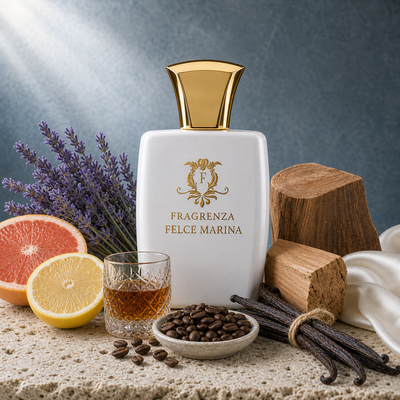
Felce Marina demonstrates how the marine register works in contemporary niche-style perfumery. Built around a fresh-marine aromatic structure with fern and clean wood support, the fragrance captures the sun-on-stone, sea-air-over-Mediterranean signature that defines a specific slice of modern aquatic perfumery. The marine impression in Felce Marina reads as atmospheric and refined rather than literal — it evokes the seashore as place rather than as substance.
This is the architecture that distinguishes modern niche marine perfumery from the 1990s-aquatic prototypes. The calone-driven, slightly synthetic impression of the early aquatic era has been refined into something more nuanced, more architectural, more genuinely Mediterranean rather than generically marine. For more on how marine accords are constructed, see our notes-in-perfumery archive.
Genuine Touch — The Clean Aromatic Cousin
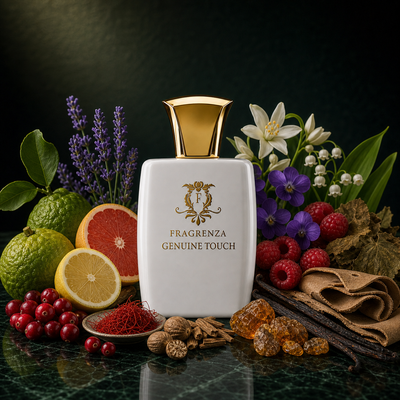
Genuine Touch occupies the clean-aromatic territory adjacent to but distinct from pure marine perfumery. While Felce Marina explicitly references the marine register through its calone-and-aromatic structure, Genuine Touch builds a clean, fresh, modern aromatic signature that captures the same emotional space — freshness, atmospheric lightness, daytime-appropriate sophistication — without committing to the literal marine impression.
The distinction matters because not every wearer wants the marine register specifically. The fresh-aromatic family includes marine fragrances as a subset but extends beyond them. Genuine Touch is the appropriate alternative for wearers who want the daytime-fresh emotional space without the seashore signaling that marine fragrances explicitly carry.
Adjacent Materials: Ozone, Air, and Salt
Sea water is often discussed alongside related but distinct accords. Ozonic accords — fresh-air impressions built around molecules like ozonil — share some characteristics with marine but read more as electrical-storm air than as ocean. Atmospheric accords use aldehydes to capture the impression of altitude and open air. Salt accords are increasingly built around synthetic salt molecules that deliver a slightly mineral, slightly oceanic quality without the full marine signature.
The careful perfumer distinguishes these adjacent materials and uses them strategically. A fragrance described as "marine" should have actual calone-driven marine signature; a fragrance described as "ozonic" should read as fresh-air-after-rain rather than as ocean spray. The marketing language sometimes blurs these distinctions, but the architectural realities are different.
How Marine Fragrances Wear Through the Day
Marine accords tend to be top-and-heart notes rather than base notes — calone is volatile and projects strongly in the opening before fading into the dry-down. Most marine fragrances follow a similar arc: a strong marine impression in the first hour, a transitional middle phase where the marine begins to blend with the supporting heart notes, and a base phase where the marine has largely faded and the supporting woods, musks, or warm notes carry the wear.
This arc has practical implications. Marine fragrances reward fresh application — they're at their best in the first 2 to 4 hours after spraying. For all-day wear, supplement with a refresh at midday, or choose a fragrance that uses the marine accord as a brief opening rather than as the dominant signature.
How to Wear Marine Fragrances
Marine fragrances are most effective in warm weather, where the cool, slightly salty impression contrasts pleasingly with the heat. They also work well in temperate spring and fall conditions. In cold winter weather, marine fragrances can read as anemic — the freshness that pleases in heat feels under-dressed against cold air.
Apply marine fragrances generously to pulse points — marine accords project less than warm-base fragrances, and 3 to 4 sprays is often appropriate where 2 sprays would suffice for an oriental. For more on application strategy, see our pulse-point guide and the application guide.
Related Reads
- Ambergris as a perfumery note
- Seaweed in perfumery
- Anatomy of a perfume
- Different fragrances for different occasions
- Travel-friendly perfumes
- Perfume storage tips
- Where to apply your perfume
Frequently Asked Questions
Is sea water in perfume actually from the sea?
No. The marine impression in modern perfumery is built from synthetic molecules — primarily calone, along with helional, floralozone, and various proprietary captives. Real sea water has no useful aroma for perfumery; the salt-and-mineral impression people associate with the ocean is largely an atmospheric phenomenon that perfumers reconstruct synthetically. The synthetic marine accord is a 20th-century invention.
Why do marine fragrances often smell similar?
Most marine fragrances built before 2010 used calone as the primary marine molecule, which created strong architectural similarities across compositions. Modern niche marine fragrances have expanded the marine palette with newer synthetic molecules, but the core calone signature still anchors most marine perfumery. The similarity isn't lack of imagination; it's the dominant role of a single molecule in defining a whole category.
Are marine fragrances better in summer?
Yes, generally. The cool, slightly salty marine impression contrasts pleasingly with summer heat in ways that warm-base fragrances can't. Marine fragrances in winter can read as anemic against cold air. The exception is heavily warmed marine fragrances — those that combine the marine accord with sandalwood, amber, and warm woods — which can extend into fall and even mild winter wear.
How do I tell marine from aquatic from ozonic?
Marine fragrances have a specific salt-and-seashore signature driven by calone and related molecules. Aquatic is a broader category that includes marine fragrances along with watery floral and fresh-river-like compositions. Ozonic fragrances emphasize fresh-air impressions and often read as electrical-storm-after-rain rather than as ocean. The categories overlap but aren't identical.
Can marine fragrances be unisex?
Yes, more than almost any other fragrance family. The marine architectural register reads as fresh and atmospheric rather than as explicitly masculine or feminine, which is why marine fragrances dominated the 1990s unisex revolution. Both Felce Marina and Genuine Touch wear unisex on skin and are appropriate across the gender spectrum.
Will marine fragrances date as quickly as 1990s aquatics?
Probably not. The 1990s aquatic revolution overused calone in ways that gave the category a strong period signature — those fragrances now smell distinctly of their era. Modern marine perfumery uses calone more carefully and supplements it with other materials, producing compositions that read as architecturally refined rather than as period-specific. Felce Marina and similar modern marines are unlikely to age in the same way 1990s aquatics did.
The Bottom Line
Sea water in perfumery is a synthetic accord that captures the impression of seashore air rather than literal ocean water. Built primarily around calone and supporting materials, the marine register has defined a generation of fresh-aquatic perfumery and remains one of the most important architectural families in modern fragrance. Felce Marina and Genuine Touch represent the modern, refined evolution of this category — marine and clean-aromatic compositions calibrated for contemporary wear rather than 1990s-era projection. Understanding the marine register architecturally gives you the literacy to navigate one of the most important note categories in modern perfumery.