Best Cardamom Fragrances 2026: The Five Archetypes from Ombre Leather to Clean Skin
Cardamom's 1,8-cineole gives it a mentholated coolness that black pepper lacks, which is why Parfums de Marly Layton and Tom Ford Ombre Leather both rely on it for bridge work.
By Julia MorettiFragrenza makes several of the alternatives featured in our guides — here’s how we test.
13 min read
Cardamom is one of the most architecturally versatile spices in fine perfumery. Where black pepper reads as dry-aggressive and pink pepper as top-note-bright, cardamom reads as warm-aromatic with cooling-mentholated undertones — a spice that bridges aromatic-fresh and warm-oriental registers more reliably than any other material in the perfumer's spice cabinet. The category has been central to Indian and Middle Eastern perfumery for over a thousand years and reached new commercial prominence between 2016 and 2026 through Parfums de Marly Layton, Tom Ford Ombre Leather, and the broader niche-prestige aromatic-oriental wave. This is the commercial buyer's edit organized around the five archetypal directions cardamom perfumery has settled into.
For the conceptual deep-dive on cardamom as a perfumery material, our Cardamom in Perfumery educational pillar covers the chemistry and cultural history in depth. This article is the dedicated cardamom buyer's edit.
What cardamom actually is in fine perfumery
Cardamom oil comes from the seed pods of Elettaria cardamomum, a member of the ginger family native to southern India and now cultivated principally in India, Guatemala, and Sri Lanka. The pods are hand-harvested green and dried before steam distillation — labor-intensive enough that cardamom is among the most expensive spices in commercial trade. The aromatic complexity comes from the seeds inside the pods rather than the pod shells; pre-extracted seed oil is the preferred fine-fragrance material.
Three chemical compounds define cardamom's character. 1,8-cineole (eucalyptol) is the dominant compound — cool, slightly mentholated, with a fresh-eucalyptus character that gives cardamom its distinctive cooling sensation. Alpha-terpinyl acetate contributes the warm-spicy, slightly woody body that anchors the cool top. Linalool (also abundant in lavender) provides the floral-aromatic bridge between top and base. The ratio between these three is unusual — cardamom is one of the few spices where the cooling material (cineole) outweighs the warming material in volume but is balanced in perceived character by the slower-evaporating spicy compounds.
This cool-warm contradiction is what makes cardamom so architecturally versatile. The cineole reads as fresh-aromatic in the opening (where most spices read as warm-aggressive), then the warm-spicy compounds emerge as the cineole fades, giving the wear a temperature-shift that no other single spice material delivers. Quality cardamom perfumery exploits this shift; weak compositions either suppress the cineole (losing what makes cardamom distinctive) or amplify it without warm support (producing a medicinal-camphoraceous wear that reads as harsh).
The cultural arc — from ancient attar to modern niche-prestige
Cardamom has one of the longest commercial fragrance histories of any spice.
Ancient through early-modern: Middle Eastern and Indian perfumery. Cardamom has been a fixture of Middle Eastern attar perfumery and Indian Mughal-tradition fragrance for over a thousand years. The note appears in many traditional Arabic perfumery blends alongside saffron, rose, and oud — the architecture that contemporary Middle Eastern fine fragrance still uses today.
1990s-2000s: niche Western reintroduction. Cardamom appeared occasionally in late-twentieth-century Western perfumery (Etro Cardamomo 1989 being the canonical niche reference) but did not become a recognizable commercial category in mass-market terms. The note was more often a supporting structural element than a foregrounded headline character.
2010-2015: contemporary masculine cardamom wave. Creed Aventus (2010) used cardamom alongside pineapple and birch in one of the most commercially successful masculine launches of the 2010s. Tom Ford Tobacco Oud (2013) folded cardamom into a dark-oriental tobacco composition. Dolce & Gabbana The One demonstrated cardamom in a fougère-spice register. By 2015 cardamom had become a structural fixture of contemporary masculine perfumery.
2016: Parfums de Marly Layton. The composition that established cardamom in the niche-prestige aromatic-oriental register. Apple, mandarin, lavender, cardamom, violet, geranium, jasmine, gaiac wood, patchouli, sandalwood, vanilla — Layton became one of the most influential niche-masculine launches of the late 2010s and shaped contemporary cardamom perfumery's apple-cardamom-aromatic register.
2018: Tom Ford Ombre Leather. The cardamom-leather pairing that defined a new commercial register. Cardamom paired with leather, jasmine, oakmoss, and amber — a composition that pushed cardamom into the contemporary leather-luxury moment and shaped multiple subsequent launches (and dupes) through 2026.
2023: Tom Ford Bitter Peach. Cardamom alongside pink pepper opens the dark-boozy peach register the iter-23 Best Peach pillar covers. Cardamom's role in 2026 commercial perfumery extends across every fragrance family from masculine fougère through feminine floral-oriental.
Famous cardamom fragrances worth knowing
Several compositions deserve study because they show what cardamom can do at the headline or structurally. Etro Cardamomo (1989) is the niche-reference cardamom soliflore. Creed Aventus (2010) is the contemporary masculine commercial reference where cardamom sits in the opening alongside pineapple. Tom Ford Tobacco Oud (2013) demonstrates cardamom in a dark-oriental register. Parfums de Marly Layton (2016) is the niche-prestige reference and the composition that defined the apple-cardamom-aromatic direction. Tom Ford Ombre Leather (2018) is the cardamom-leather cultural reference. Acqua di Parma Colonia Pura demonstrates cardamom in a Mediterranean-citrus register that contemporary niche cologne perfumery has refined. The Fragrenza catalog interpretations span five contemporary cardamom directions covered below.
Five archetypal cardamom directions in 2026
Each direction has its own typical use case, its own seasonal register, and its own Fragrenza pick distributed inline. All five picks have Cardamom explicitly tagged in their official Shopify product descriptions — §16.2 compliance is direct rather than via disclaimer.
1. Cardamom-leather contemporary (the Ombre Leather register)
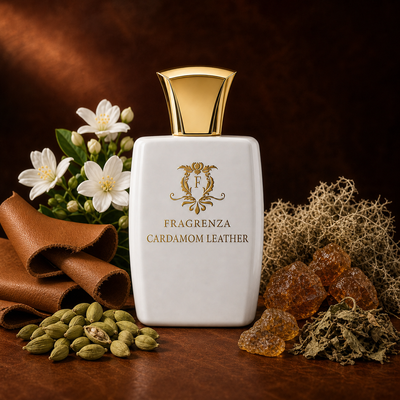
The keystone luxury archetype. Cardamom paired with supple leather, jasmine sambac, oakmoss, and amber — the niche-luxury direction that Tom Ford Ombre Leather defined in 2018 and that has shaped contemporary cardamom-leather perfumery. Reads as confident, evening-leaning, classically sophisticated. Best for evening wear, cool weather, and anyone drawn to the architectural complexity of cardamom-anchored leather compositions. The closest Fragrenza match:
2. Aromatic-niche apple-cardamom (the Layton register)
The niche-prestige aromatic archetype. Cardamom paired with apple, lavender, mandarin, violet, geranium, and a sandalwood-vanilla base — the niche-prestige direction that Parfums de Marly Layton defined in 2016 and that has shaped contemporary masculine perfumery. Reads as polished, evening-flexible, distinctly modern-luxury. Best for evening wear and anyone drawn to the niche-prestige interpretation of cardamom. The closest Fragrenza match:
(Erba Speziata) — a Parfums de Marly Layton-inspired composition with apple, mandarin, and lavender opening; violet, geranium, jasmine, and cardamom at the heart; gaiac wood, patchouli, sandalwood, pepper, and vanilla at the base. The right pick for wearers who want cardamom integrated into a complex aromatic-oriental composition.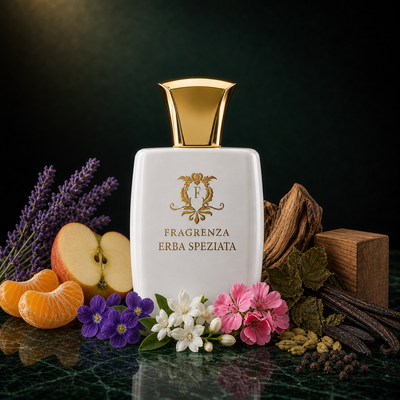
3. Soft-spice cardamom-floral (the warmth-and-comfort register)
The accessible feminine archetype. Cardamom paired with ripe peach, white flowers, rose, cinnamon, clove, and a tonka-cashmere musk base — the warm-spiced-floral direction that contemporary feminine commercial perfumery has refined. Reads as comforting, cool-weather-friendly, broadly wearable. Best for daily wear and anyone who wants cardamom as warmth-and-comfort rather than statement. The closest Fragrenza match:
(Bontà) — velvety ripe peach, luminous mandarin and orange, and aromatic cardamom opening; white flowers, rose petals, cinnamon, and clove at the heart; sandalwood, powdery tonka bean, and cashmere musks at the base. The cardamom defines the warm-aromatic character that bridges the fruity opening to the floral-spiced heart.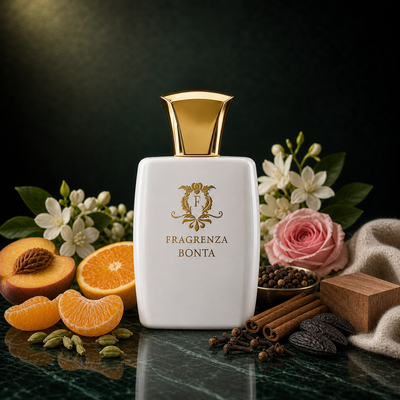
4. Mediterranean-oriental cardamom (the Amalfi register)
The contemporary Mediterranean-oriental archetype. Cardamom paired with quince, apple, saffron, clove, frankincense, tolu balsam, and a vanilla-cedarwood-tonka base — the sun-warmed Mediterranean direction that contemporary luxury niche perfumery has refined. Reads as opulent, evening-flexible, distinctly Mediterranean-luxurious. Best for evening wear, cool weather, and anyone drawn to compositions that pair cardamom with Mediterranean-oriental warmth. The closest Fragrenza match:

5. Clean-skin cardamom (the modern unisex register)
The contemporary skin-scent archetype. Cardamom paired with orange blossom, rose, geranium, rosemary, lavender, nutmeg, coriander, and a sandalwood-musk base — the modern unisex aromatic register that bridges cardamom into the C9 Skin Scents 2.0 crossover territory. Reads as clean, daily-wear flexible, broadly approachable. Best for daily wear and anyone drawn to cardamom in a transparent, skin-close composition rather than a dense leather-oriental architecture. The closest Fragrenza match:
— orange blossom and lemon opening; rose, geranium, rosemary, lavender, nutmeg, coriander, and cardamom at the heart; lychee, tonka bean, teak wood, sandalwood, vetiver, and musk at the base. The cardamom sits in the heart as part of a complex aromatic accord; the wear stays skin-close throughout. The most universally-wearable cardamom entry point in the catalog.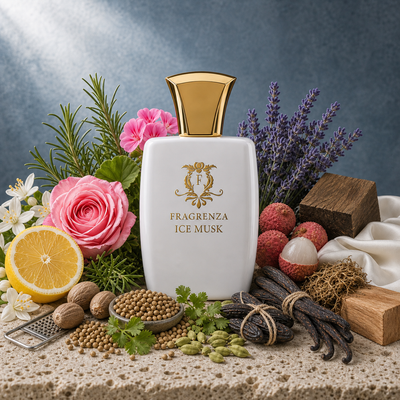
How cardamom fragrances wear on skin
Cardamom compositions wear specifically. Three patterns worth knowing.
The cool-warm shift is the wear. Cardamom is structurally unusual in opening cool-aromatic (cineole-dominant) and transitioning to warm-spicy (terpinyl acetate-dominant) as the wear develops. The shift typically occurs around 60-90 minutes on skin and is the defining cardamom experience. Wearers who reject cardamom on a sharp-medicinal opening often miss the warm-spicy heart and base where the composition rewards.
Cardamom carries longer than most spices. Unlike pink pepper (top-note-only) or black pepper (top-and-early-heart), cardamom integrates into heart and base with notable persistence. Quality cardamom compositions retain identifiable cardamom character 4-6 hours into wear. This is why cardamom appears as a structural element in so many contemporary niche compositions — it provides aromatic continuity that lighter spices cannot.
Skin chemistry shapes the wear. The cineole-vs-terpinyl-acetate ratio interacts with skin pH and oils. Warmer or oilier skin amplifies the warm-spicy facet (terpinyl); cooler or drier skin amplifies the cool-aromatic facet (cineole). The same composition can read as warm-spiced on one wearer and cool-mentholated on another. See the skin chemistry deep-dive for the full mechanism.
When and how to wear cardamom
The cardamom register is broadly seasonal-flexible. The cardamom-leather (Cardamom Leather register) and Mediterranean-oriental (Piaceri da Amalfi register) are cool-weather and evening-coded. The aromatic-niche (Erba Speziata register) handles autumn through spring across daytime and evening. The soft-spice cardamom-floral (Bontà register) is autumn-winter daytime friendly. The clean-skin cardamom (Ice Musk register) is the year-round daily-wear exception — light enough for warm weather, distinctive enough for cool.
For application, cardamom rewards moderate volume. Two sprays is sufficient for most cardamom compositions; one for the heaviest leather-oriental compositions. For the broader wardrobe framework, our wardrobe pillar covers how cardamom fits alongside other spice families.
How to layer cardamom fragrances
Three reliable layering patterns work within the cardamom register.
Pattern 1: cardamom over a clean musk base. Spray a clean musk on pulse points first, then apply the cardamom composition over it. The musk softens the projection and extends the cardamom dry-down — particularly useful for the cardamom-leather and Mediterranean-oriental archetypes when daytime wear is required.
Pattern 2: cardamom + vanilla pulse points. Apply the cardamom composition to chest and wrists, then a small amount of pure vanilla to inner elbows. The vanilla amplifies the warm-spicy heart-base bridge without overwhelming the cool cineole opening.
Pattern 3: cardamom + rose for the niche-luxury direction. The cardamom-rose pairing produces one of the most architecturally rewarding aromatic-oriental wears. Apply the cardamom composition first, then layer a rose composition over the heart — particularly effective for the aromatic-niche (Erba Speziata) and Mediterranean-oriental (Piaceri da Amalfi) archetypes.
Anti-pattern: do not layer cardamom under aquatic compositions. The cool-mentholated facet of cardamom clashes with cool-aquatic sharpness rather than complementing it. For the broader layering framework, our layering pillar covers the principles.
Building a cardamom rotation
A two-bottle cardamom setup covers most use cases — one architecturally complex evening pick (Cardamom Leather for the keystone leather-luxury register, or Erba Speziata for the niche-prestige aromatic) and one daily-wear pick (Ice Musk for the clean-skin register, or Bontà for the soft-spice feminine warmth). A three-bottle rotation adds the Mediterranean-oriental (Piaceri da Amalfi) for cool-weather evening variety. A five-bottle rotation covers all five archetypes.
The cardamom register pairs naturally with the iter-29 Best Pink Pepper Fragrances (the modern Bitter Peach-era spice pairing), the iter-30 Best Lavender for Men (cardamom and lavender are the two structural aromatics of contemporary niche-masculine perfumery), and the iter-31 Best Patchouli Fragrances (cardamom-patchouli is a structural pattern across many contemporary compositions).
Who each pick is for
If you want the keystone cardamom-leather Ombre Leather register: Cardamom Leather.
If you want the niche-prestige aromatic Layton register: Erba Speziata.
If you want soft-spice cardamom-floral feminine warmth: Bontà.
If you want Mediterranean-oriental cardamom with saffron and frankincense: Piaceri da Amalfi.
If you want clean unisex cardamom in a skin-scent register: Ice Musk.
If you're not sure where you sit: The Fragrenza sample pack covers the full range — three-day testing on skin is the only way to discover which cardamom register your chemistry amplifies.
Frequently asked questions
What does cardamom smell like in perfume?
Simultaneously cool-mentholated and warm-spicy — cardamom is structurally unusual for opening with a cineole-driven cool-eucalyptus character and transitioning to warm-aromatic terpinyl-acetate as the wear develops. The temperature-shift around 60-90 minutes is the defining cardamom experience. Quality cardamom perfumery captures both facets; weak compositions either lose the cool opening (becoming generic warm-spice) or amplify it without warm support (becoming harsh-medicinal).
What is the difference between cardamom and other spices in perfumery?
Cardamom is uniquely versatile because of its cool-warm structural character. Pink pepper is bright-fruity-top-note-only; black pepper is dry-aggressive-medium-volatility; cinnamon is warm-sweet-throughout; nutmeg is dense-warm-base-leaning; saffron is warm-leathery. Cardamom bridges most of these by opening cool and transitioning warm. This is why cardamom appears in more contemporary niche commercial compositions than any other single spice except pink pepper.
Is cardamom feminine or masculine?
Genre-fluid. Cardamom appears in masculine niche (Aventus, Layton, Tobacco Oud), feminine commercial (cardamom-rose chypres), unisex contemporary (Ombre Leather, Ice Musk-register compositions), and traditional Middle Eastern attar perfumery (where Western gender categories don't fully apply). Treat cardamom gender marketing as a starting point rather than a constraint.
How long do cardamom fragrances last on skin?
Eight to twelve hours is typical for full cardamom compositions on average skin. The dense base materials supporting cardamom (leather, amber, vanilla, sandalwood, patchouli) carry the wear past the spice fade. Cardamom itself integrates into heart and base with notable persistence — quality cardamom compositions retain identifiable cardamom character 4-6 hours into wear. The Ice Musk-register skin-scent crossover wears slightly shorter (6-9 hours).
Can cardamom fragrances be worn in summer?
The clean-skin cardamom (Ice Musk register) handles warm-weather contexts well — light enough to project without overwhelming. The aromatic-niche (Erba Speziata register) handles spring through autumn. The cardamom-leather, soft-spice feminine, and Mediterranean-oriental archetypes are cool-weather compositions; the dense base materials project too aggressively in heat. Save those three for autumn, winter, and cool spring evenings.
What perfumes layer well with cardamom?
Three reliable directions: clean musk (softens projection of dense cardamom compositions), vanilla (amplifies the warm-spicy heart-base bridge), and rose (the cardamom-rose pairing is one of contemporary perfumery's great structural pairings). Avoid layering cardamom under aquatic compositions — the cool-mentholated facet clashes with cool-aquatic sharpness.
What is the best cardamom fragrance for beginners?
The clean-skin cardamom archetype (Ice Musk register) is the most universally-wearable entry point because the cardamom sits within a complex aromatic accord that stays skin-close throughout the wear, the composition handles a wider range of contexts than the heavier leather-oriental archetypes, and the daily-wear flexibility is exceptional. Start there, learn how your skin amplifies the cineole-vs-terpinyl-acetate ratio over a season, and decide whether to explore the niche-prestige Erba Speziata direction, the cardamom-leather Cardamom Leather register, the soft-spice Bontà feminine warmth, or the Mediterranean-oriental Piaceri da Amalfi depth.
The bottom line
Cardamom is one of the most architecturally versatile materials in fine perfumery and one of the most rewarding to learn deeply. The five archetypes give you the full contemporary commercial landscape — cardamom-leather luxury, niche-prestige aromatic, soft-spice feminine warmth, Mediterranean-oriental, and clean-skin modern unisex — and the Fragrenza picks within each give you concrete starting points across the range. All five picks contain verified cardamom materials per their official product descriptions; §16.2 compliance is direct rather than via disclaimer.
Whether you want the keystone luxury depth of Cardamom Leather, the niche-prestige aromatic complexity of Erba Speziata, the soft-spice feminine warmth of Bontà, the Mediterranean-oriental opulence of Piaceri da Amalfi, or the clean unisex daily wear of Ice Musk, the contemporary cardamom family has the depth to reward years of exploration. Three-day skin testing on your own chemistry reveals which archetype your skin amplifies and which becomes a long-term part of your rotation.