

The Best Leather Fragrances: Civilised, Sensual, and Dangerously Sophisticated
There is no leather extraction, so cuir de Russie depends on smoky birch tar distillate alongside Suederal and isobutyl quinoline for the modern accord.
By Julia MorettiFragrenza makes several of the alternatives featured in our guides — here’s how we test.
13 min read
Of all the fragrance families that depend on animalic or skin-like character to achieve their effect, leather is the most civilised. Oud has darkness and mystery; musk has raw intimacy; ambergris has oceanic strangeness. Leather has something different: the smell of human craft and industry, of materials worked and transformed by skilled hands, of things built to last and improve with use. A great leather fragrance smells simultaneously ancient and modern, wild at its origins and disciplined in its refinement.
This is the guide. What leather actually is in perfumery (since there is no “leather oil” in the way there is patchouli oil or oud oil), the materials and synthetics that build a leather accord, the spectrum of leather expressions from raw and tarry to soft and powdery, the famous leather fragrances of the last century, and six Fragrenza picks distributed across the registers the note plays in. Read in order or skip to the section you need.
What leather actually is in perfumery
The first thing to understand about leather perfumery is that there is no natural leather essential oil. Unlike rose, jasmine, or sandalwood, leather is not a material that yields its character to extraction. The leather accord is, instead, a constructed effect — an architecture built from a combination of natural and synthetic materials that, blended together, create the olfactory impression of worked hide. The construction of a convincing leather accord is one of perfumery’s most technically demanding challenges, which is why the finest leather fragrances tend to come from the most skilled perfumers.
The historical foundation of leather perfumery is birch tar — a smoky, slightly petroleum-like distillate of birch bark that has been used in fragrance and in the actual leather-tanning industry for centuries. Birch tar gives the “Russian leather” or cuir de Russie accord its raw, smoky, almost campfire character. The downside of pure birch tar is that it can read as harsh or even chemical at higher concentrations, and modern fragrance regulation has tightened restrictions on the unrefined material due to skin-sensitization concerns.
The contemporary leather toolkit is more varied. Iso E Super contributes the woody, dry-clean facet that gives modern leather compositions their refined character (our Iso E Super pillar covers this molecule in detail). Norlimbanol — a powerful synthetic woody molecule — provides an almost animalic dryness used sparingly for depth. Castoreum (the synthetic equivalent of beaver-derived material) adds warm, leathery-amber depth. Suederal and similar synthetic suede materials produce the soft, powdery leather facet that defines the suede-leather subcategory. Quinolines (particularly isobutyl quinoline) deliver a slightly herbaceous, leathery-tobacco character used in classical chypre-leather compositions. Most modern leather accords blend several of these materials at low percentages, with the proportions calibrated to the specific leather expression the perfumer is aiming for.
The leather family spectrum
Leather is not a single smell. The category covers a remarkable range, and learning to recognize the major sub-families is most of what reading leather perfumery requires.
Raw leather — smoky, animalic, slightly tarry, the closest to the campfire-and-saddle smell that the imagination associates with leather. The classic cuir de Russie accord (Chanel Cuir de Russie 1924, Knize Ten 1925) sits here. These are statement compositions, often demanding and not universally accessible.
Suede — smooth, powdery, soft, with the slightly velvety character of brushed hide rather than tanned leather. Guerlain Cuir Beluga and many of the contemporary soft-leather compositions sit in this register. Suede leathers tend to be the most universally wearable of the family.
Aldehydic leather — bright, slightly soapy leather with a glamour edge that the aldehyde top notes provide. Chanel Cuir de Russie’s aldehydic version is the canonical example. The structure adds polish and luxury to what would otherwise be a more austere leather composition.
Leather chypre — leather over oakmoss and labdanum, contrasting with bright bergamot and citrus top notes. The structure is one of the most sophisticated in fine perfumery and produced many of the great mid-twentieth-century luxury feminines (Bandit, Cabochard, Diorling).
Tobacco leather — dark, warm, deeply masculine, with the leather paired with tobacco, vanilla, and warm spices for a smoky-sweet richness. This is the contemporary masculine leather direction that Tom Ford Tuscan Leather and similar compositions defined for the 2010s.
Floral leather — leather with violet, iris, or osmanthus to soften and complicate the wear. Fahrenheit’s violet-leather-gasoline structure is the most famous example; the Fragrenza interpretation,
(Centigrado), holds the same odd, brilliant register.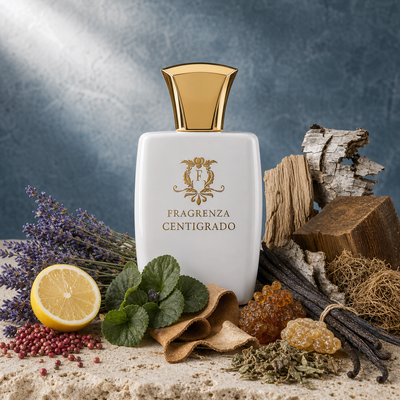
Cultural history of leather perfumery
Leather perfumery has its origins in seventeenth-century Spain and France, where leather goods (gloves especially) were perfumed both to cover the strong tanning smell and as a luxury affectation. By the early eighteenth century, “peau d’Espagne” (Spanish skin) had become a fragrance category in its own right — a leather-and-amber composition originally used for scented gloves and then sold as a perfume in its own form. The category grew through the nineteenth century alongside the broader development of fine perfumery.
The early twentieth century produced the classics that still define the category. Chanel’s Cuir de Russie (1924) and Knize Ten (1925) are both still in production almost a century later, and both still read as recognizably the same compositions despite reformulation. Robert Piguet’s Bandit (1944) gave the leather-chypre register its most assertive expression. The post-war decades produced refinements and variations rather than fundamental innovations.
The contemporary leather moment began in the 1990s with the niche perfumery movement and has continued through the 2010s and 2020s with compositions like Tom Ford Tuscan Leather (2007), Tom Ford Ombré Leather (2018), and a broad wave of unisex leather compositions that have moved the category beyond its mid-century masculine and feminine pigeonholes. The leather perfumery of 2026 is more diverse and more accessible than at any point in its commercial history.
Famous leather fragrances
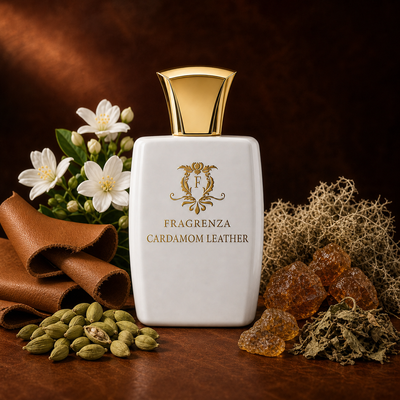
Several compositions deserve study because they show what leather can do at the headline. Knize Ten remains the genre benchmark for raw-leather perfumery — smoky, complex, distinctive, completely uncompromising. Chanel Cuir de Russie demonstrates leather in classical-chypre context. Fahrenheit’s violet-leather-gasoline structure is unlike anything else in mainstream perfumery. Tom Ford Ombré Leather brought the genre into contemporary luxury and accessible-mainstream territory; the Fragrenza interpretation in this register is
Six Fragrenza leather picks
Six compositions in the Fragrenza catalog place leather at the structural center of the wear, each in a distinct register.
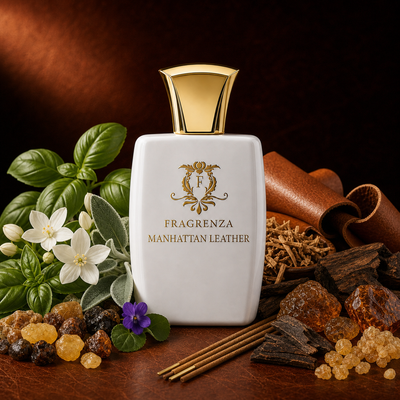
The dry urban register
approaches leather from a contemporary urban angle: not the leather of rural craftsmanship or ancient traditions but of cities, ambition, and well-made things. The opening has a metropolitan crispness that quickly gives way to a leather heart that is dry rather than animalic, and that dryness is what makes the composition one of the most wearable in the category. It is the leather pick for those who find traditional raw-leather compositions slightly too confrontational, and the one that wears comfortably in professional contexts where the heavier leathers would feel out of place.
The cardamom-leather register
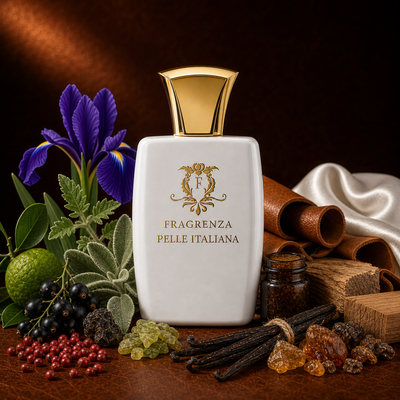
The Italian-leather register
translates Italy’s longer-than-anywhere tradition of fine leather craftsmanship into fragrance. The composition is warmer and slightly sweeter than Manhattan Leather, with a richness suited to evening wear and cooler months. The leather accord reads as luxurious rather than raw — this is the leather of fine gloves and hand-crafted bags, not industrial production. It is the leather pick for the warm-luxurious register that Italian fine-goods culture established.
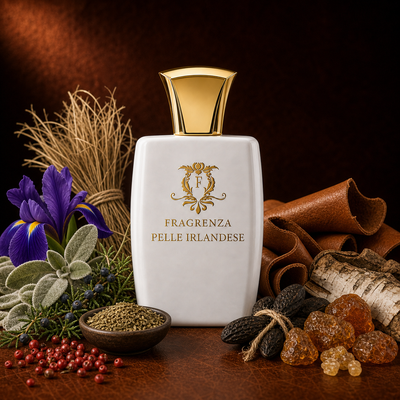
The Irish-leather register
sits alongside its Italian counterpart as the line’s second exploration of leather in a specific cultural-material tradition. Where Pelle Italiana goes warm and refined, Pelle Irlandese goes greener and slightly cooler — the leather of the British Isles tradition rather than the Mediterranean one. It is the leather pick for those who want the note in a cooler, more aromatic register.
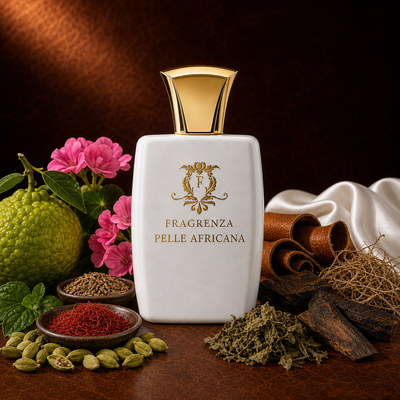
The exotic-leather register
takes leather into a richer, more exotic territory — warmer than Pelle Italiana, with deeper resin and spice notes that anchor the leather in a more orientalist tradition. It is the leather pick for cool-weather evenings and for anyone who wants the note in its most opulent register.
The violet-leather register
(Centigrado) holds the strange, brilliant violet-leather-gasoline territory that the original Fahrenheit defined for masculine perfumery in 1988. The composition is unlike anything else in the leather family — floral and metallic and leathery all at once, with a coolness that contrasts with the warmer leather expressions. It is the leather pick for anyone who wants the note in its most distinctive and original register.
How leather interacts with other notes
Leather is one of perfumery’s great structural materials precisely because it pairs productively with such a wide range of categories.
With bergamot and citrus, leather forms the classical chypre-leather contrast that has defined luxury perfumery since the 1920s. Bright top, dark base, connected by florals and aromatic herbs.
With tobacco and vanilla, leather creates the warm-sweet-smoky register that defines contemporary masculine compositions like Tom Ford Tuscan Leather and the broader tobacco-leather direction. Our tobacco-and-leather piece covers this pairing in detail.
With oud, leather amplifies oud’s woody-resinous character and produces some of the most luxurious oriental compositions in the modern canon. The pairing is a fixture of niche-luxury perfumery.
With rose, leather produces the rose-leather chypre that has anchored luxury feminine perfumery for almost a century. The contrast between fresh-floral and dark-tarry is one of the most elegant in fine fragrance.
With vetiver, leather’s smoky facets reinforce the vetiver’s mineral-cool character, producing the urban-chypre register that defines many of the great masculine compositions.
With osmanthus, leather meets a soft floral with apricot facets to produce the apricot-leather accord that has become one of the genre’s contemporary signatures.
Leather in the modern wardrobe
Leather is most at home in autumn and winter, when its warmth and depth feel appropriate to the season, and in evening contexts where its sophistication has room to develop. Lighter suede and floral-leather compositions can stretch into spring and summer wear, but the heavier raw-leather and tobacco-leather compositions belong to cool weather. The wear rewards confidence: leather is among the most assertive registers in modern perfumery and is best worn intentionally rather than tentatively.
Most well-built fragrance wardrobes include at least one leather composition. The category fills a register no other can fill — the civilised-sensual middle ground between the polished-clean register of fougere and the fully-animalic register of oud or animalic musk. For a single leather pick, the dry-urban Manhattan Leather or the warm Italian-leather Pelle Italiana wear most universally; for more specialized contexts, the cardamom-leather, violet-leather, or exotic-leather picks each occupy distinct registers.
For broader context on how leather-forward compositions fit a wardrobe, our complete guide to building a fragrance wardrobe in 2026 places leather alongside the major base-note categories. For the mood register leather occupies — confident, sensual, sophisticated — our guide to choosing perfume by mood covers the territory in detail. For the underlying note, our leather in perfumery educational pillar provides the foundational explainer.
Frequently asked questions
What does leather smell like in perfume?
Leather in perfumery is not a single smell but a constructed accord. At one end of the spectrum it reads as smoky, slightly tarry, and animalic (the raw-leather or cuir-de-Russie register); at the other, soft, powdery, and skin-warm (the suede register). Most contemporary leather compositions sit between the two, combining a clean leather impression with warm woods, tobacco, smoke, or florals to produce a composition that reads as worked hide rather than as raw chemistry.
Where does the leather smell come from in perfume?
From a constructed accord built from natural and synthetic materials. Birch tar is the historical foundation (smoky, slightly petroleum-like). Modern compositions use Iso E Super, Norlimbanol, castoreum (synthetic), suede materials like Suederal, and quinolines like isobutyl quinoline at low percentages, blended to produce the specific leather character the perfumer is aiming for. There is no natural leather essential oil; every leather note in fine fragrance is the work of compositional craft.
Are leather fragrances only for men?
No. The masculine association is a mid-twentieth-century convention rather than something inherent to the note. Many of the great leather compositions of the early-twentieth century (Cuir de Russie, Bandit, Cabochard, Tabac Blond) were marketed and worn as feminine, and the contemporary leather wave is genuinely unisex. The qualities that define great leather perfumery — sophistication, depth, civilised sensuality — are not gendered. Suede and floral-leather compositions in particular have made the category fully accessible across genders.
Are leather fragrances long-lasting?
Yes — among the most long-lasting in fine perfumery. The materials that build a leather accord (birch tar derivatives, Iso E Super, Norlimbanol, castoreum) are heavy molecules that evaporate slowly from skin. A leather-forward composition typically wears for ten to fourteen hours, often with the leather character emerging more strongly through the dry-down as lighter top notes burn off. This longevity is part of why leather has been a structural fixture of fine perfumery for almost two centuries.
What is the best season for leather fragrances?
Autumn and winter for the heavier raw-leather, tobacco-leather, and warm Italian-leather compositions, where the warmth and depth fit cool weather. Lighter suede and floral-leather compositions can wear comfortably in spring and even summer, particularly in evening contexts. The constraint is concentration: a heavy leather composition feels oppressive on a hot summer afternoon; the lighter expressions wear across all four seasons without difficulty.
How do I start with leather fragrance if I find the category challenging?
Start with a softer expression. Suede compositions and floral-leathers are the most accessible entry points to the category — the leather note is present and recognizable, but it has been refined and contextualized in ways that make the wear less demanding than a raw cuir-de-Russie composition. Once you have developed familiarity with leather in modulated context, the more assertive expressions become more rewarding. The Manhattan-Leather-style dry urban leather is also a good starting point: leather without the animalic intensity of the traditional compositions.
What perfumes layer well with leather?
Tobacco for the warm-sweet-smoky direction. Vanilla for softness and depth. Oud for the niche-luxury oriental register. Rose for the chypre-leather pairing. Cardamom and warm spices for the contemporary masculine direction. Vetiver for the urban-chypre register. Avoid layering leather with sharp aquatic or marine notes — the contrast between dry-warm and cool-aquatic tends to read as awkward rather than complementary.
The bigger picture
Leather is the most civilised of perfumery’s animalic registers and one of the most rewarding categories to learn. The genre rewards engagement: the compositions are technically demanding, the materials are powerful, and the wear is among the most distinctive in fine fragrance. Whether you wear leather for the dry urban register, the cardamom-warm masculine, the Italian-luxurious, the violet-strange, or the exotic-resinous, the category belongs in any serious fragrance wardrobe. Learning to recognize leather — in its various sub-families and at the structural level of countless other compositions — is one of the most useful skills any fragrance lover can develop.